




Table of Contents
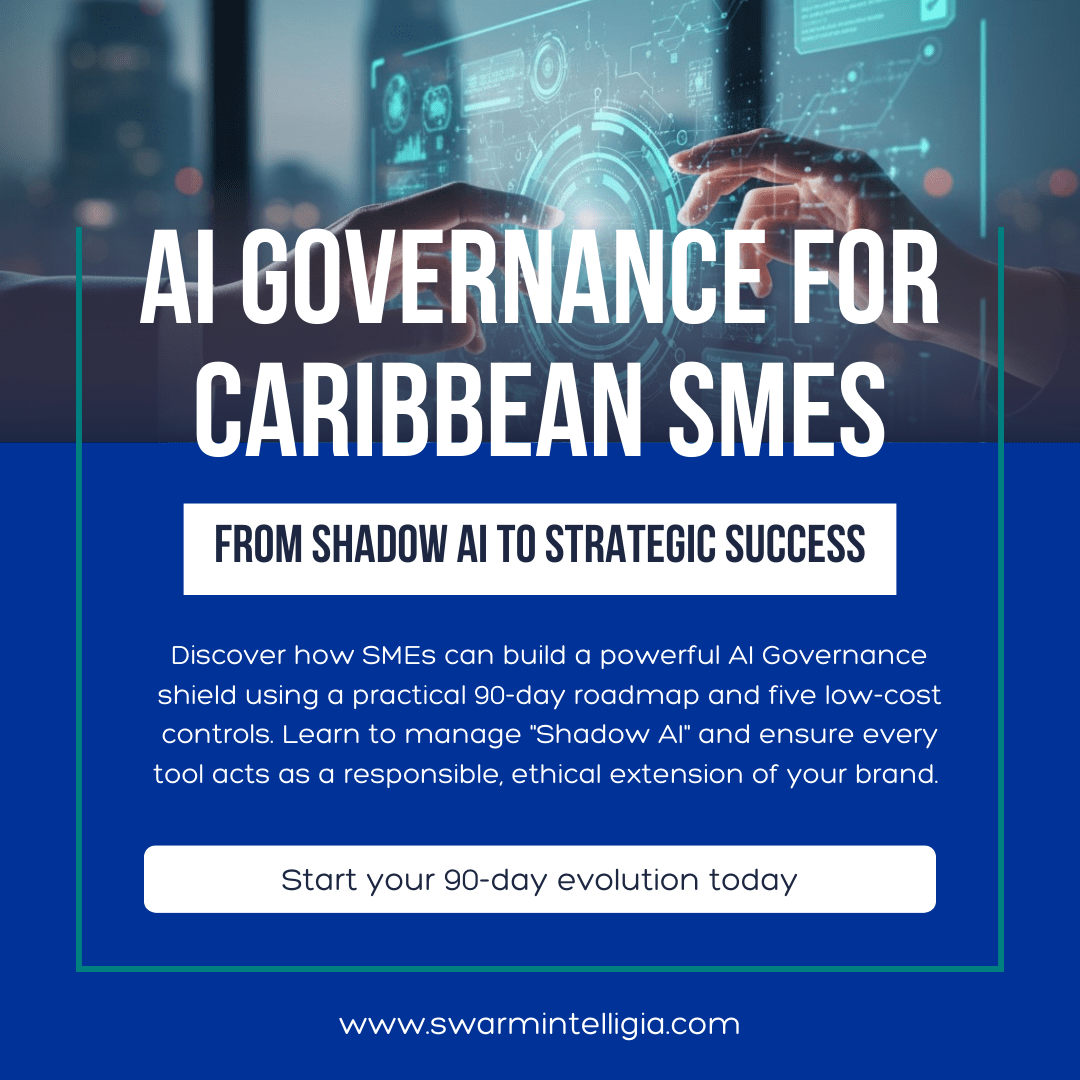
While AI promises a massive leap in productivity, many SMEs are “acting now and regulating later.” This is a gamble. AI governance isn’t a complex legal framework reserved for large corporations—it is a critical shield for your brand. Whether your team is using AI to analyse sensitive data or generate marketing content, accountability ensures the technology works as a responsible extension of your business, not against it.
You don’t need an enterprise-grade budget to build a safe environment. By implementing a few foundational guardrails, you can move from “shadow AI” to strategic, confident adoption. Here is how to build a governance framework that works for your SME —not against it.
In the rush to integrate AI, many SMEs are operating without a strategic framework, exposing themselves to significant unforeseen risks. The right response is not to halt innovation but to establish clear governance. At its core, AI governance encompasses the policies, standards, and frameworks that ensure your use of AI is responsible, secure, fair, ethical, accountable, and compliant. Frameworks such as the NIST AI RISK MANAGEMENT FRAMEWORK provide a solid roadmap, but for a busy SME, adopting such frameworks wholesale can be overwhelming.
Fortunately, SMEs don’t need a dedicated compliance department to get this right. The most effective path to AI governance is built on a foundation most SMEs already understand: the core principles of Governance, Risk, and Compliance (GRC). By applying this proven framework, SMEs can align their AI strategy with business goals, mitigate risks proactively, and foster a culture of accountability—all without disrupting operations. For most SMEs, this process begins with five high-impact steps that cost almost nothing to implement.
Step 1: Appoint an AI Champion
Accountability is the first step. Designate one curious, responsible employee from IT, operations, or marketing to be your part-time “AI Champion.”
- Not a new hire: This role requires 1-2 hours per week to stay informed on AI risks.
- Goal: They become the internal “go to” person for AI questions and best practices.
Investing in your AI Champion through education, quality resources, and hands-on training will strengthen both the individual and your organisation’s capabilities. Broadening that training to all staff—with an emphasis on privacy, security, and ethical use—helps create the cultural shift that makes governance stick.
Step 2: Embed simple, risk-based processes into existing workflows
When a new AI solution is proposed, integrating it into existing workflows requires a risk assessment. This will check for things like bias, data privacy, and security. Templates and checklists should be developed to guide users. SMEs should follow this simple process:
- Establish a Living AI Registry: You cannot govern what you don’t know exists. Create a simple spreadsheet that tracks every tool used across departments—including “Shadow AI” your marketing team may have signed up for last week. Key fields include tool name, department owner, type of data accessed (e.g., “Public only” vs. “Customer PII”), and associated risk level.
- Create a Risk Assessment: A risk assessment helps you focus limited time and resources where they matter most. Categorise your AI use cases by the level of autonomy you grant them—this keeps high-risk decisions under human control while letting low-risk automation thrive.
Step 3: The Two-Page “Acceptable Use Policy” (AUP)
Forget the 50-page legal documents. Your team needs a clear, two-page document outlining:
- Approved vs. Banned Tools: Which platforms are vetted for company data?
- The “No-Go” Data List: Explicitly ban inputting trade secrets or customer personally identifiable information into public AI.
- The Human-in-the-Loop: A mandate that all AI output must be reviewed by a human before being published.
Step 4: Data Security & Ethical Practices
Your governance framework must include basic data security controls. This means applying encryption for sensitive data, establishing clear access controls so only authorised staff interact with AI tools, and enforcing ethical practices—such as testing for bias—to ensure your systems treat all users fairly.
Step 5: Foster a Sustainable AI Culture
Governance should be part of the culture, not just a rule book. Create feedback loops where staff can report issues, and reward those who use AI responsibly. Training must be ongoing because AI is always changing. This ensures the AI GRC program stays effective over time. To learn how SMEs can bridge the AI skills and capabilities gaps, review our Data Analytics & AI Solutions for Caribbean SMEs.
SMEs should not try to do this in a weekend. Follow this 90-day evolution to pace your rollout.
Phase 1: Accountability & Assessment (Days 1–30)
- Identify your AI Champion.
- Conduct a “no-blame” audit to see what tools teams are actually using.
- Populate your AI Registry and identify the most dangerous “unmanaged” uses.
Phase 2: Implementation (Days 31–60)
- Publish the AUP: Hold an “All Hands” meeting to explain the why behind the policy.
- Create a Vetting Process: Use a simple 3-question “Request Form” for new tools.
- Pilot a Vetted Tool: Roll out a secure, enterprise version of an LLM with proper security settings.
Phase 3: Monitoring & Scaling (Days 61–90)
- Quarterly Review: A 1-hour “AI Council” meeting (CEO, IT Lead, Dept Head) to review the registry.
- Share Prompt Libraries: Distribute “safe” and effective prompt templates to boost productivity.
- Vendor Check: Ask your software vendors for their AI disclosure and privacy guarantees.
Conclusion
Artificial intelligence presents a tremendous opportunity for SMEs to innovate and compete. But a powerful tool without guardrails is a liability. AI governance is not about restricting progress—it is about building a foundation of trust with your customers and confidence within your teams. Governance is also not a one-time activity. Continuous monitoring and regular auditing of AI systems will help SMEs to identify emerging risks, adapt to evolving challenges, and maintain transparency with all stakeholders.
These five steps:
- Establishing ownership
- Embedding processes
- Defining acceptable use
- Securing your data, and
- Fostering a responsible culture
will give your SME the foundation it needs for confident AI adoption. By focusing on practical GRC principles, you are not just managing risk; you are building a more resilient, competitive, and future-ready organisation. The question is no longer whether your SME should govern its AI—it is whether you can afford not to. Start small, stay consistent, and let these five guardrails grow with your ambitions.
European Parliament. (2025, 02 19). EU AI Act: first regulation on artificial intelligence. Retrieved from https://www.europarl.europa.eu/topics/en/article/20230601STO93804/eu-ai-act-first-regulation-on-artificial-intelligence.
Araiza, R. (2025, 06 30). AI & Data Security: Enhancing Data Protection in the Digital Age. Retrieved from Fortra: https://www.digitalguardian.com/blog/ai-data-security-enhancing-data-protection-digital-age
Catenacci, C., & Cooke, T. (2025, 05 28). Right-sizing AI governance: Starting the conversation for SMEs. Retrieved from iapp: https://iapp.org/news/a/right-sizing-ai-governance-starting-the-conversation-for-smbs
GDPR.EU. (n.d.). Complete guide to GDPR compliance. Retrieved from https://gdpr.eu/
Gomstyn, A., & Jonker, A. (n.d.). Exploring privacy issues in the age of AI. Retrieved from IBM: https://www.ibm.com/think/insights/ai-privacy
Haan, K., & Watts, R. (2023, April 24). How Businesses Are Using Artificial Intelligence. Retrieved from Forbes: https://www.forbes.com/advisor/business/software/ai-in-business/
Joshi , H., & Vaidya, S. (2024). Empowering Responsible AI Adoption: A Human-in-the-Loop Framework for Small and Medium Enterprises (SMEs). International Journal of Management and Organizational Research, 66-73.
Joswig, T., & Kurz, W. (2025). Regulatory and Compliance Requirements for SMEs Operating AI Systems through Data Centers in the EU, with a Focus on Data Protection Challenges in Germany. Retrieved from Journal of Next-Generation Research 5.0: https://jngr5.com/index.php/journal-of-next-generation-resea/article/view/89
Mayer, H., Yee, L., Chui, M., & Roberts, R. (2025, January 28). Superagency in the workplace: Empowering people to unlock AI’s full potential. Retrieved from McKinsey & Company: https://www.mckinsey.com/capabilities/tech-and-ai/our-insights/superagency-in-the-workplace-empowering-people-to-unlock-ais-full-potential-at-work
Navigate ethical and regulatory issues of using AI. (2024, 07 01). Retrieved from Thomson Reuters: https://legal.thomsonreuters.com/blog/navigate-ethical-and-regulatory-issues-of-using-ai/
NIST Information Technology Laboratory. (n.d.). AI Risk Management Framework. Retrieved from National Institute of Standards and Technology (NIST): https://www.nist.gov/itl/ai-risk-management-framework/nist-ai-rmf-playbook
Onoja, J. P., Hamza, O., Collins, A., Chibunna, U. B., Eweje, A., & Daraojimba, A. I. (2021, January 27). Digital Transformation and Data Governance: Strategies for Regulatory Compliance and. Journal of Frontiers in Multidisciplinary Research, pp. 43-55.
Quantum Black AI by McKinsey. (2025, March 12). Retrieved from McKinsey: https://www.mckinsey.com/capabilities/quantumblack/our-insights/the-state-of-ai
Roxanne Paul is an experienced Strategic Human Resources and Organization Development Professional with deep expertise in architecting and executing impactful strategies across talent management, organizational effectiveness, and Governance, Risk & Compliance (GRC). She brings a multidimensional perspective to solving complex business challenges.
She is passionate about partnering with organizations to build resilient organizations where talent thrives, risk is managed intelligently, and compliance is woven into the cultural fabric.